Free CompTIA CY0-001 Practice Questions 2026 - Page 2

Timed Practice Test

Think You're Ready?

Your Final Exam Before the Final Exam.
Dare to Take It?

Faculty members at a university are concerned about potential inherent bias and inconsistency in one department's AI plagiarism detection service. Which of the following principles will most likely address their concerns?

A. Transparency

B. Explainability

C. Consistency

D. Accountability

B.   Explainability

Explanation:

Explainability is the principle that most directly addresses concerns about inherent bias and inconsistency in an AI plagiarism detection service. Explainability refers to the ability to understand, interpret, and articulate how an AI model arrives at its decisions or predictions in a human-understandable manner. When faculty members question bias or inconsistency—meaning the same submission might receive different scores, or certain writing styles are unfairly flagged—explainability allows them to audit the model's reasoning. It provides transparency into which features (e.g., n-gram overlap, semantic similarity, writing patterns) influenced the plagiarism score, enabling educators to identify whether the model is disproportionately flagging certain writing styles, non-native English patterns, or commonly used phrases. Without explainability, the system remains a "black box," making it impossible to diagnose or correct bias. Explainability builds trust, enables validation, and supports continuous improvement of the AI system.

Why the other options are incorrect:

A. Transparency:
Transparency involves openly disclosing how the AI system works, including its training data, development process, and limitations. While related and important, transparency is more about disclosure than understanding. It tells faculty what the system does but does not provide the detailed, per-decision reasoning needed to diagnose bias and inconsistency in individual cases.

C. Consistency:
Consistency ensures the model produces the same output for identical or similar inputs over time. However, consistency does not address how the decision was made—it only ensures reproducibility. A model can be consistently biased without revealing that bias, so consistency alone does not address the core concern.

D. Accountability:
Accountability assigns responsibility for the AI system's outcomes to specific individuals or roles. It ensures someone is answerable for the system's performance but does not provide the technical insight required to identify or correct bias and inconsistency in the model's decision-making process.

References:

CompTIA SecAI+ CY0-001 Exam Objectives: Domain 1.4 (AI Ethics and Responsible AI – Explainability and Interpretability).

NIST AI RMF (Playbook):Identifies explainability as a key trustworthiness characteristic for high-risk AI applications.

A penetration tester is assessing the controls of a deployed AI system that is designed to search and return the contents of files.
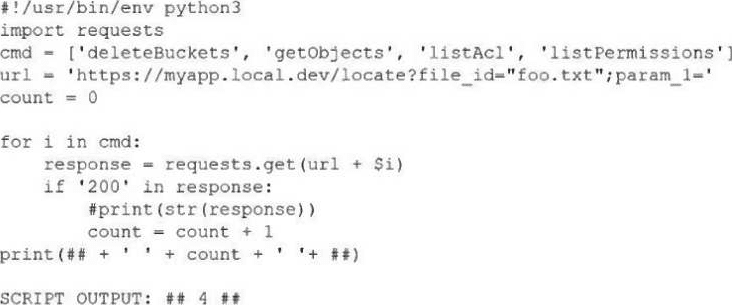
The tester runs the following:
Which of the following is the best control to prevent abuse of the system?

A. Implementing custom detection rules for anomalous model behavior

B. Segmenting the workload into a separate virtual private cloud (VPC)

C. Adding a large language model (LLM) guardrails library to the application code

D. Reducing the privilege scope of the service account

D.   Reducing the privilege scope of the service account

Explanation:

Reducing the privilege scope of the service account is the best control to prevent abuse of this system. The script demonstrates a command injection or privilege escalation vulnerability where the penetration tester is iterating through administrative commands—deleteBuckets, getObjects, listAcl, listPermissions—via the file_id parameter. The fact that these commands execute successfully (indicated by 200 responses and a count of 4) proves the service account running the AI application has excessive privileges far beyond what is required for its core function of searching and returning file contents. By applying the principle of least privilege, the administrator should restrict the service account to only the specific permissions needed—such as readObjects within a designated bucket—and explicitly deny administrative or destructive operations. This immediately neutralizes the attacker's ability to execute privileged commands, regardless of other vulnerabilities.

Why the other options are incorrect:

A. Custom detection rules for anomalous model behavior:
Detection rules would identify suspicious activity after it occurs, not prevent the abuse. The script's commands would still execute successfully, causing potential damage before any alert is triggered. Prevention is superior to detection.

B. Segmenting the workload into a separate VPC:
VPC segmentation is a network-level isolation control that limits lateral movement. However, it does not address the underlying issue—the service account itself has excessive permissions. The attacker could still execute privileged commands within the segmented environment.

C. Adding an LLM guardrails library to the application code:
LLM guardrails filter or validate inputs and outputs at the application layer. However, the vulnerability is not prompt injection—it is a direct API call with a crafted parameter. The script bypasses the LLM entirely and interacts directly with the backend filesystem or cloud storage API. Guardrails would not intercept this backend request.

References:

CompTIA SecAI+ CY0-001 Exam Objectives: Domain 3.1 (Securing AI Systems – Identity and Access Management, Least Privilege) and Domain 2.2 (Threats to AI Systems – Privilege Escalation).

Which of the following is most resistant to AI manipulation?

A. Payloads

B. AI-generated content

C. Application programming interface (API) gateway

D. Attack surface reduction

E. Antivirus

C.   Application programming interface (API) gateway

Explanation:

An API gateway is the most resistant to AI manipulation because it operates as a strict, rule-based intermediary between clients and backend services. Unlike AI models, which are probabilistic and susceptible to adversarial inputs, prompt injection, and data poisoning, an API gateway enforces deterministic security controls—including rate limiting, authentication (API keys, OAuth, JWT), input validation, request filtering, IP allowlisting/denylisting, and payload size restrictions. These controls are configured by administrators and do not rely on machine learning or natural language processing, making them immune to the adversarial manipulation techniques that target AI systems. Even if an attacker crafts a sophisticated adversarial prompt or poisons training data, the API gateway remains an independent, hardcoded barrier that enforces security policies without interpretation or deviation. This deterministic nature gives it inherent resistance to AI-specific threats.

Why the other options are incorrect:

A. Payloads:
Payloads are the data being transmitted and can be easily crafted or manipulated by attackers using AI-generated content. They are the attack vector, not a defensive control.

B. AI-generated content:
AI-generated content itself can be manipulated through prompt injection, adversarial inputs, or fine-tuning attacks. It is the source of the threat, not a resistance mechanism.

D. Attack surface reduction:
This is a security strategy that minimizes exposed entry points. While effective, it does not inherently resist AI manipulation—it reduces opportunities but does not actively defend against adversarial inputs that reach the remaining surface.

E. Antivirus:
Traditional antivirus relies on signature-based detection and is increasingly ineffective against AI-generated polymorphic malware. AI can easily evade signature matching, making antivirus highly susceptible to AI manipulation.

References:

CompTIA SecAI+ CY0-001 Exam Objectives: Domain 3.1 (Securing AI Systems – API Security and Gateway Controls) and Domain 3.2 (Implementing AI Security Controls – Input Validation, Rate Limiting).

OWASP API Security Top 10 (API1-API10): Highlights API gateways as foundational for enforcing authentication, authorization, and throttling.

Which of the following is the primary security risk when deploying AI models in production?

A. Graphics processing unit (GPU) acceleration

B. Model overfitting

C. Model encryption

D. Data exposure

D.   Data exposure

Explanation:

Data exposure is the primary security risk when deploying AI models in production because AI systems inherently process, store, and generate vast amounts of sensitive information—including personally identifiable information (PII), intellectual property, financial records, and proprietary business data. Unlike traditional applications, AI models can inadvertently memorize training data and leak it through inference attacks such as model inversion, membership inference, and prompt extraction. These attacks allow adversaries to reconstruct individual training records or infer whether specific data was used in training, all without breaching the underlying database. Additionally, production AI systems expose APIs that can be queried thousands of times, providing attackers with repeated opportunities to extract sensitive information through carefully crafted inputs. Data exposure also carries severe regulatory consequences under GDPR, HIPAA, and CCPA, making it the highest-stakes security concern.

Why the other options are incorrect:

A. Graphics processing unit (GPU) acceleration:
GPU acceleration is a performance optimization for training and inference, not a security risk. While GPUs may have theoretical side-channel vulnerabilities (e.g., cache timing attacks), these are not the primary production risk.

B. Model overfitting:
Overfitting is a performance issue where a model memorizes training data instead of generalizing. While it increases the risk of data exposure through model inversion, overfitting itself is a machine learning engineering problem, not a direct security risk. Data exposure is the actual threat caused by overfitting.

C. Model encryption:
Model encryption protects proprietary model weights at rest or in transit. It is a security control, not a risk. Encryption does not expose data—it protects it.

References:

CompTIA SecAI+ CY0-001 Exam Objectives: Domain 2.2 (Threats to AI Systems – Model Inversion, Membership Inference, Data Leakage) and Domain 3.2 (Implementing AI Security Controls – Data Protection).

OWASP Top 10 for LLMs (LLM06): Sensitive Information Disclosure—specifically warns against data exposure through AI outputs

An AI security administrator receives an inquiry about an unusually high monthly bill from the AI solution provider. The administrator thinks the majority of staff might be using the most powerful model available. Which of the following AI measures should the administrator implement to lower costs?

A. Storage monitoring

B. Modality types

C. Prompt firewalls

D. Token limits

D.   Token limits

Explanation:

Token limits are the most direct and effective measure to lower costs when staff are overusing powerful AI models. Most commercial AI solutions charge based on token consumption—the number of input (prompt) and output (completion) tokens processed per request. High token usage directly correlates with higher monthly bills. By implementing token limits, the administrator can enforce per-user, per-session, or per-day caps, preventing excessive usage of the most powerful (and expensive) models. Token limits can be configured at the API gateway or application layer to throttle requests, truncate overly long prompts, restrict output length, or route excessive queries to more cost-effective smaller models. This provides immediate, granular cost control while maintaining operational availability.

Why the other options are incorrect:

A. Storage monitoring:
Storage monitoring tracks data storage volume and costs, not inference or API usage. The inquiry is about high monthly bills from AI model usage, not data storage fees. Storage monitoring does not address token consumption.

B. Modality types:
Modality refers to the data types a model can process (e.g., text, image, audio, video). Restricting modalities would limit functionality but does not directly lower costs—staff could still generate excessive text tokens. This is a capability control, not a cost control.

C. Prompt firewalls:
Prompt firewalls are security controls that filter or block malicious inputs (e.g., prompt injection, jailbreaks). They do not enforce usage quotas or token caps. While they protect against attacks, they do not reduce token consumption from legitimate staff queries.

References :

CompTIA SecAI+ CY0-001 Exam Objectives: Domain 3.1 (Securing AI Systems – API Security and Usage Controls) and Domain 3.2 (Implementing AI Security Controls – Rate Limiting and Quotas).

NIST AI RMF (Playbook): Recommends establishing usage policies and resource limits to manage operational costs.

A data scientist is working with unlabeled data and wants to build a clustering model. Which of the following techniques should a data scientist use?

A. Supervised learning

B. Reinforcement learning

C. Unsupervised learning

D. Semi-supervised learning

C.   Unsupervised learning

Explanation:

Unsupervised learning is the correct technique for building a clustering model with unlabeled data. Unsupervised learning algorithms are specifically designed to find hidden patterns, structures, or groupings within datasets that lack predefined labels or target variables. Clustering—including algorithms like K-Means, DBSCAN, and hierarchical clustering—is a core unsupervised learning task that groups similar data points based on feature similarity. The algorithm does not require labeled examples; it identifies natural clusters by minimizing intra-cluster variance and maximizing inter-cluster distance. This makes unsupervised learning ideal for exploratory data analysis, customer segmentation, anomaly detection, and pattern discovery where no ground truth labels exist.

Why the other options are incorrect:

A. Supervised learning:
Supervised learning requires labeled data—each training sample must have a known output or target variable (e.g., classification labels or regression values). Since the data scientist is working with unlabeled data, supervised learning is not feasible for clustering.

B. Reinforcement learning:
Reinforcement learning is a paradigm where an agent learns to make sequential decisions by receiving rewards or penalties through interaction with an environment. It is used for control problems, game-playing, and robotics—not for clustering unstructured datasets.

D. Semi-supervised learning:
Semi-supervised learning uses a small amount of labeled data combined with a large amount of unlabeled data to improve model performance. While it can work with some unlabeled data, it still requires at least some labeled examples. The question explicitly states the data scientist is working with unlabeled data, making semi-supervised learning unsuitable.

References:

CompTIA SecAI+ CY0-001 Exam Objectives: Domain 1.1 (Data Science and AI Lifecycle – Machine Learning Types) and Domain 1.2 (AI Concepts – Unsupervised Learning).

Google ML Crash Course: Defines unsupervised learning as finding patterns in unlabeled data, with clustering as the primary task.

A developer is selecting authentication controls for an AI system. Which of the following is the best way to prevent threat actor replay attacks?

A. Identity provider (IdP) federation

B. Secure Shell (SSH)-based certificate authentication

C. Expiring session tokens

D. Identity and access management access keys

C.   Expiring session tokens

Explanation:

Expiring session tokens are the most effective control to prevent replay attacks, where an attacker intercepts a valid authentication token and reuses it to impersonate a legitimate user. By implementing short-lived session tokens with built-in expiration times (e.g., JWTs with short exp claims, OAuth 2.0 access tokens with limited lifetimes, or SAML assertions with time constraints), the system ensures that even if a token is intercepted, it becomes invalid after a short period—typically minutes to hours. This drastically reduces the attack window and forces attackers to use the token immediately, making replay attacks significantly harder to execute. For additional protection, combining expiring tokens with nonces, timestamps, or one-time-use mechanisms further mitigates replay risks.

Why the other options are incorrect:

A. Identity provider (IdP) federation:
IdP federation enables single sign-on (SSO) across multiple systems using standards like SAML or OIDC. While it centralizes authentication, it does not inherently prevent replay attacks—tokens from a federated IdP can still be intercepted and reused if they lack expiration controls.

B. Secure Shell (SSH)-based certificate authentication:
SSH certificates are used for secure remote access to servers and infrastructure, not for API or application-level authentication in AI systems. SSH does not address token replay in AI application contexts.

D. Identity and access management (IAM) access keys:
IAM access keys (e.g., AWS access keys) are long-lived static credentials used for programmatic access to cloud resources. They are highly vulnerable to replay attacks because they remain valid until manually revoked, making them the opposite of a replay-resistant control.

References:

CompTIA SecAI+ CY0-001 Exam Objectives: Domain 3.1 (Securing AI Systems – Authentication, Session Management, and Token Security).

NIST SP 800-63B (Digital Identity Guidelines): Recommends short-lived session tokens and frequent re-authentication to mitigate replay attacks.

A security analyst needs to conduct a security assessment of the output from an AIenabled development tool. Which of the following should the analyst do first?

A. Remove hard-coded secrets from the source code.

B. Enforce strict access controls for code repositories.

C. Enable sensitive data discovery on code repositories.

D. Perform a source code review.

D.   Perform a source code review.

Explanation:

Performing a source code review is the first and most critical step when assessing the output from an AI-enabled development tool. AI-generated code can contain vulnerabilities, insecure patterns, logic errors, or even malicious code fragments—often referred to as "hallucinated" or "suggested" code that lacks proper security validation. A manual or automated source code review allows the security analyst to examine the generated code for common weaknesses such as injection flaws (SQL, OS command), insecure deserialization, improper error handling, hard-coded credentials, and business logic flaws. This assessment must occur before any other security controls are applied because the analyst needs to understand what the AI produced. Code review provides the foundational security analysis upon which additional controls are built.

Why the other options are incorrect:

A. Remove hard-coded secrets from the source code:
Removing secrets is a remediation step, not an assessment step. The analyst must first review the code to identify hard-coded secrets before removing them. Performing removal without review may miss other critical vulnerabilities.

B. Enforce strict access controls for code repositories:
Access controls govern who can view or modify the code. While important for overall code security, they are preventive controls that should already be in place, not the first assessment step. They do not evaluate the quality or security of the AI-generated output itself.

C. Enable sensitive data discovery on code repositories:
Sensitive data discovery scans for PII, credentials, or secrets in repositories. This is a subset of code review focused specifically on data exposure. However, it does not address logic flaws, injection vulnerabilities, or insecure design—making it too narrow as a first step. A comprehensive source code review encompasses sensitive data discovery and more.

References:

CompTIA SecAI+ CY0-001 Exam Objectives: Domain 3.3 (Securing AI Systems – AI Code Generation Security) and Domain 4.2 (AI for Security Operations – Code Analysis).

OWASP Top 10 (A03:2021 – Injection): Highlights code-level vulnerabilities that must be reviewed in AI-generated output.

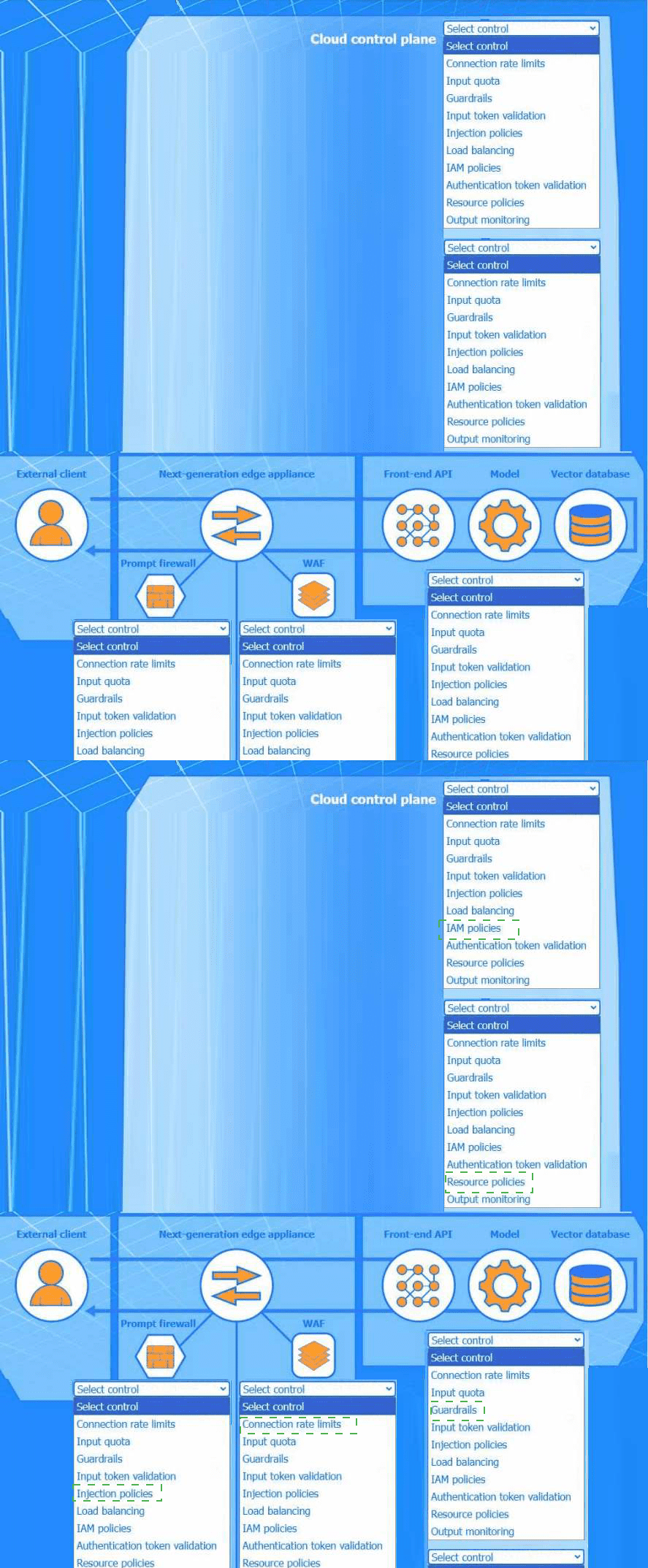
Instructions: Use the drop-down menus to define two appropriate security controls for each component of the AI system. Each control may be used only once. An engineer is deploying a new AI system and wants to integrate it into the core system through an API.
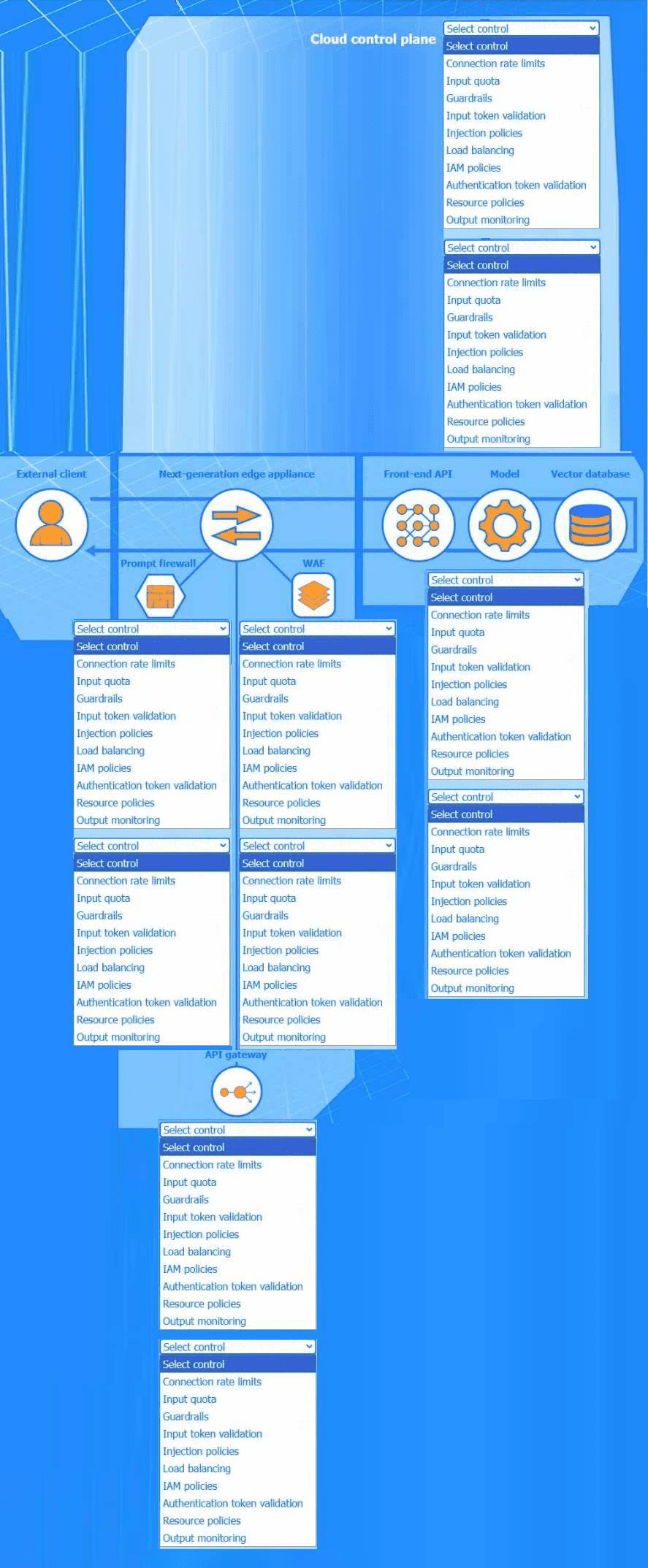


🎯 Component Control Assignments

1. Cloud Control Plane
Control 1: IAM policies

Control 2: Resource policies

2. Prompt Firewall
Control 1: Injection policies
Control 2: Output monitoring

3. WAF (Web Application Firewall)
Control 1: Connection rate limits
Control 2: Input token validation

4. API Gateway
Control 1: Load balancing
Control 2: Authentication token validation

5. Backend (Front-end API / Model / Vector Database)
Control 1: Guardrails
Control 2: Input quota

Explanation

Cloud Control Plane: Manages cloud-level access and governance using IAM policies (identity permissions) and Resource policies (restricting cloud service deployments/access).

Prompt Firewall: Specifically inspects prompt content to stop adversarial input via Injection policies and verifies generated responses using Output monitoring.

WAF: Operates at the network/application edge to protect web interfaces, controlling traffic surges via Connection rate limits and inspecting payloads via Input token validation.

API Gateway: Acts as the entry point for API requests, providing traffic distribution through Load balancing and verifying identity using Authentication token validation.

Model & Vector Database Layer: Secures the core AI execution environment using Guardrails (to restrict model generation boundaries) and Input quota (to protect against resource exhaustion and denial of service).

An AI architect reviews AI utilization and wants to improve the user experience. Which of the following should the architect review within the logs?

A. Rate monitoring

B. Model accuracy

C. Access controls

D. Data storage

B.   Model accuracy

Explanation:

Model accuracy is the log metric that directly impacts user experience. When an AI architect reviews logs to improve user experience, they need to analyze how well the model is performing its core function—delivering correct, relevant, and useful outputs. Logs containing accuracy metrics (e.g., prediction confidence scores, error rates, false positive/negative rates, or user feedback signals) reveal whether the model is meeting user expectations. Poor accuracy leads to frustrated users, wasted time, and loss of trust in the system. By reviewing accuracy trends over time, the architect can identify degradation (drift), spot problematic query patterns, and prioritize retraining or fine-tuning efforts. Accuracy logs are the most direct indicator of whether the AI is fulfilling its intended purpose from the user's perspective.

Why the other options are incorrect:

A. Rate monitoring:
Rate monitoring tracks request volume, throughput, and API throttling. While performance and latency affect user experience, rate monitoring is primarily a capacity and cost management tool. It does not tell the architect whether the model's responses are accurate or useful—only how many requests are being made.

C. Access controls:
Access controls govern who can use the system. Reviewing access logs would show authentication and authorization events, which are security and compliance concerns. They do not provide insight into the quality of the AI's outputs or user satisfaction.

D. Data storage:
Data storage logs track how much data is stored, backup status, and retrieval performance. Storage metrics relate to infrastructure and data management, not to the AI model's inference quality or user experience. Storage issues might affect availability, but they do not reveal whether the model is delivering accurate responses.

References:

CompTIA SecAI+ CY0-001 Exam Objectives: Domain 1.3 (AI Lifecycle – Model Performance Monitoring) and Domain 4.2 (AI for Security Operations – Log Analysis and Performance Metrics).

NIST AI RMF (Playbook): Emphasizes monitoring model accuracy and performance to ensure trustworthiness and user satisfaction.

Page 2 out of 13 Pages