Free CompTIA CAS-005 Practice Questions 2026 - Page 11

An administrator reviews the following log and determines the root cause of a site-to-site
tunnel failure:
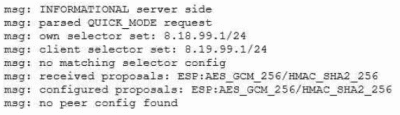
Which of the following actions should the administrator take to most effectively correct the
failure?
A. Enable perfect forward secrecy on the remote peer.
B. Update the cipher suites configured for use on the server side.
C. Add a new subnet as a permitted initiator.
D. Disable IKE version 1 and run IKE version 2.
Explanation:
The log indicates the tunnel fails because the server‑side has configured selector 8.18.99.1/24 but the client peer proposes 8.19.99.1/24. The error no matching selector config and no peer config found means the remote subnet is not allowed. The administrator must add the client’s subnet as a permitted initiator so that IPsec selectors match.
Correct Option:
C. Add a new subnet as a permitted initiator
The log shows client selector set: 8.19.99.1/24 and own selector set: 8.18.99.1/24.
The server has no matching selector configuration for the client’s subnet.
Adding 8.19.99.1/24 to the allowed initiator/protected subnets resolves the mismatch.
This is a common IPsec tunnel issue when local and remote traffic selectors do not align.
Incorrect Options:
A. Enable perfect forward secrecy on the remote peer
PFS affects key derivation (Diffie‑Hellman rekeying), not traffic selectors.
The failure is about subnet mismatch, not cryptographic key freshness. Enabling PFS will not resolve selector misalignment.
B. Update the cipher suites configured for use on the server side
The log shows proposals match: ESP:AES_GCM_256/HMAC_SHA2_256 is listed as both received and configured.
Cipher suite mismatch would cause a different error (e.g., no acceptable proposal). The actual error is selector‑related.
D. Disable IKE version 1 and run IKE version 2
The log shows QUICK_MODE, which is IKEv1 terminology. Switching to IKEv2 changes negotiation but does not fix mismatched subnets.
IKEv2 uses Child SAs, but the root cause (client subnet not permitted) remains unchanged.
Reference:
CompTIA CAS-005 Exam Objectives — Domain 2: Security Operations (Troubleshooting IPsec VPNs).
RFC 7296 (IKEv2) — Section 2.9 (Traffic Selectors).
StrongSwan/libreswan logs: “no matching selector config” indicates TS (traffic selector) mismatch.
A security engineer needs to review the configurations of several devices on the network to
meet the following requirements:
• The PostgreSQL server must only allow connectivity in the 10.1.2.0/24
subnet.
• The SSH daemon on the database server must be configured to listen
to port 4022.
• The SSH daemon must only accept connections from a Single
workstation.
• All host-based firewalls must be disabled on all workstations.
• All devices must have the latest updates from within the past eight
days.
•All HDDs must be configured to secure data at rest.
• Cleartext services are not allowed.
• All devices must be hardened when possible.
Instructions:
Click on the various workstations and network devices to review the posture assessment
results. Remediate any possible issues or indicate that no issue is found.
Click on Server A to review output data. Select commands in the appropriate tab to
remediate connectivity problems to the pOSTGREsql DATABASE VIA ssh
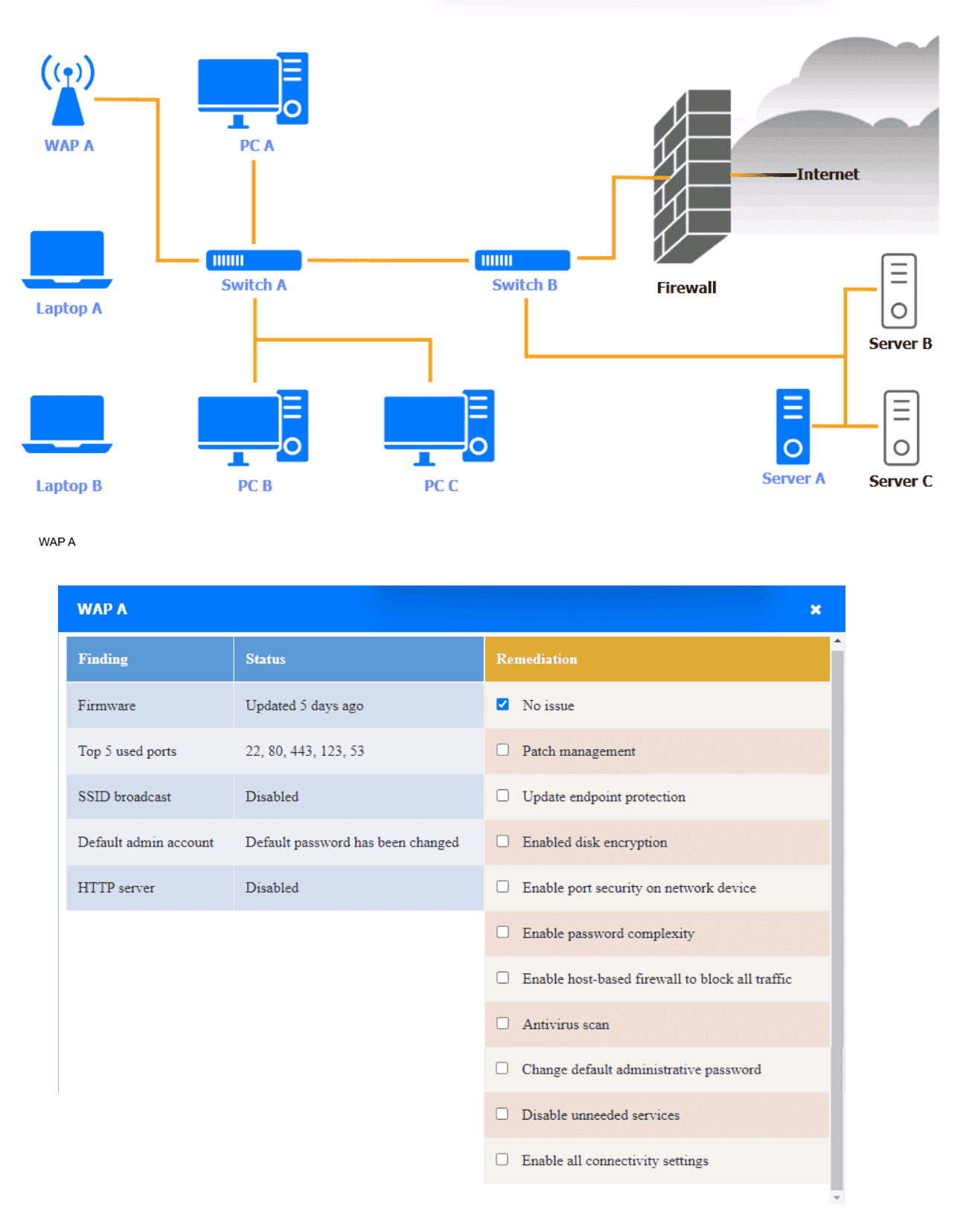
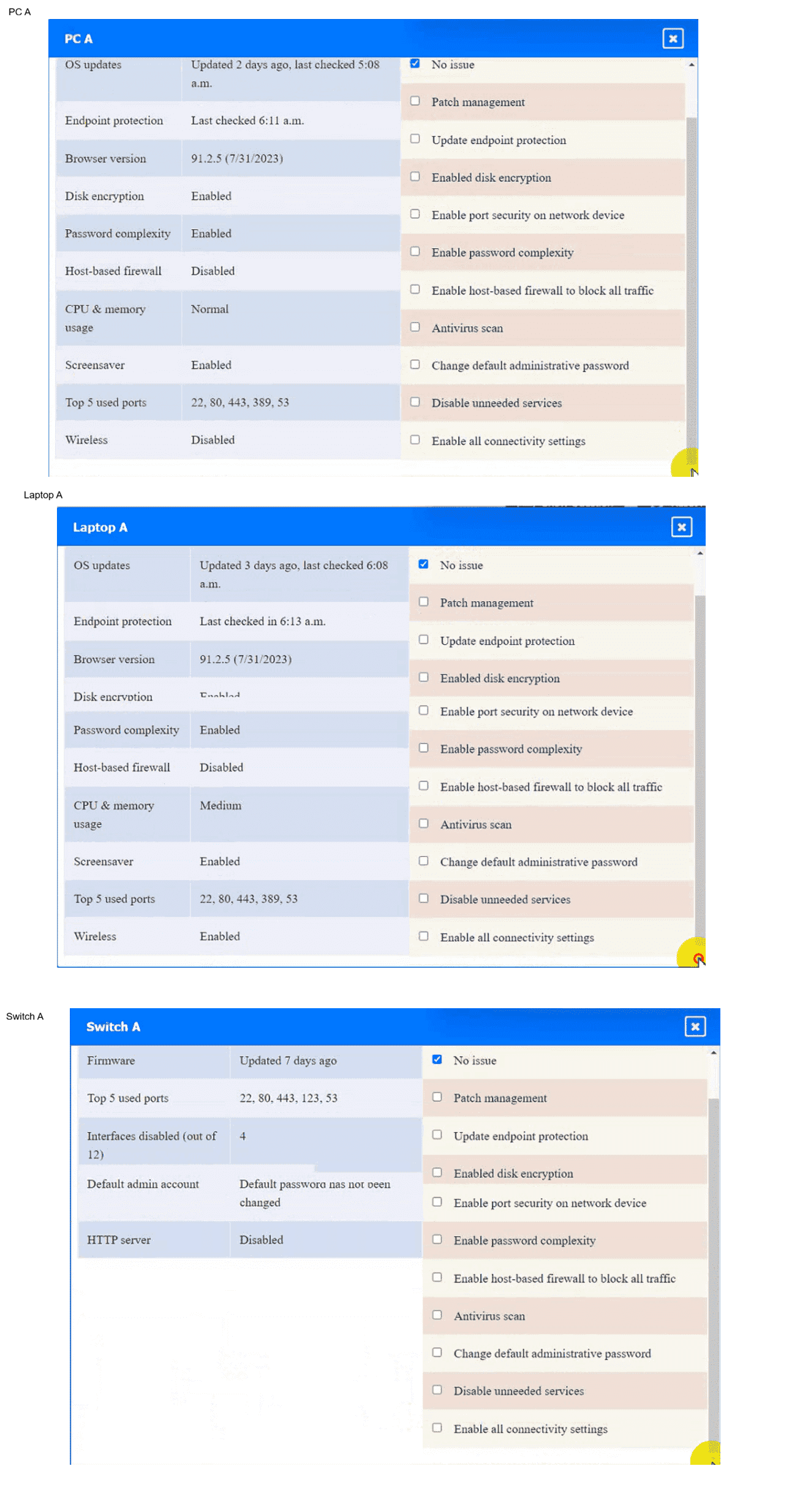
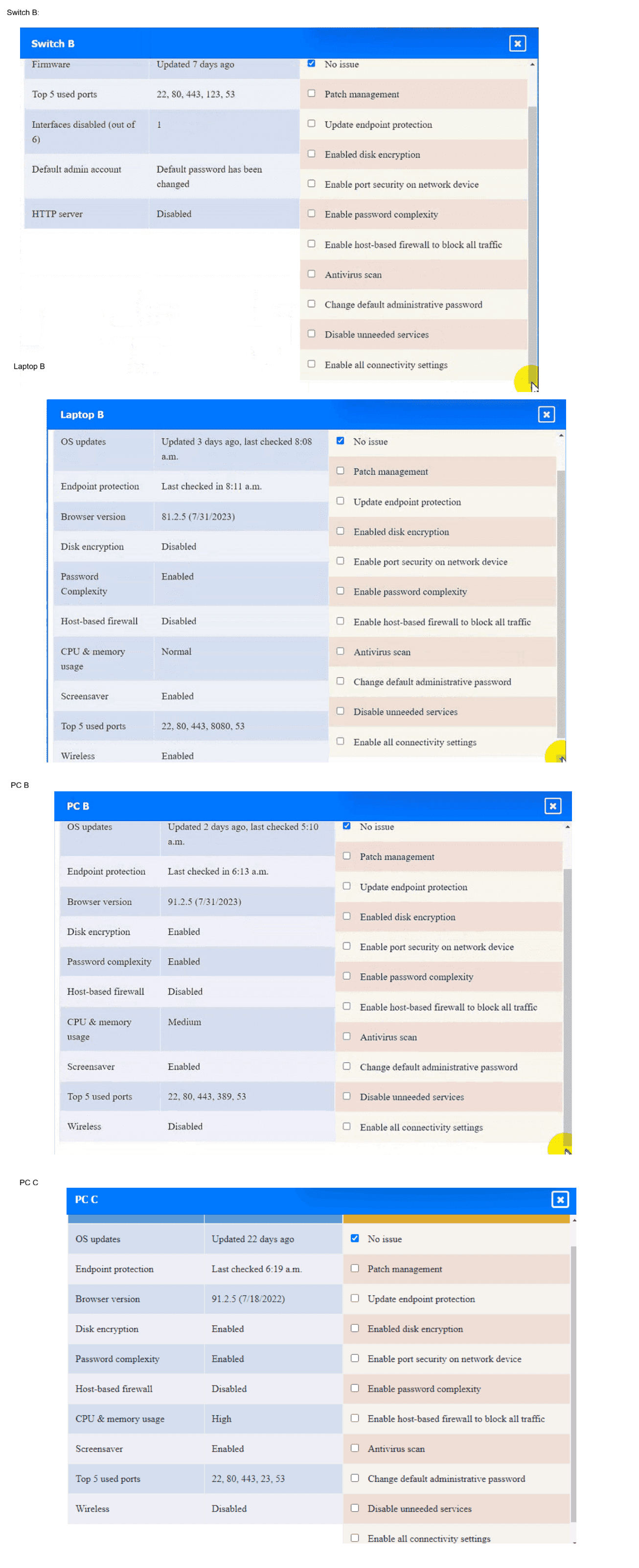
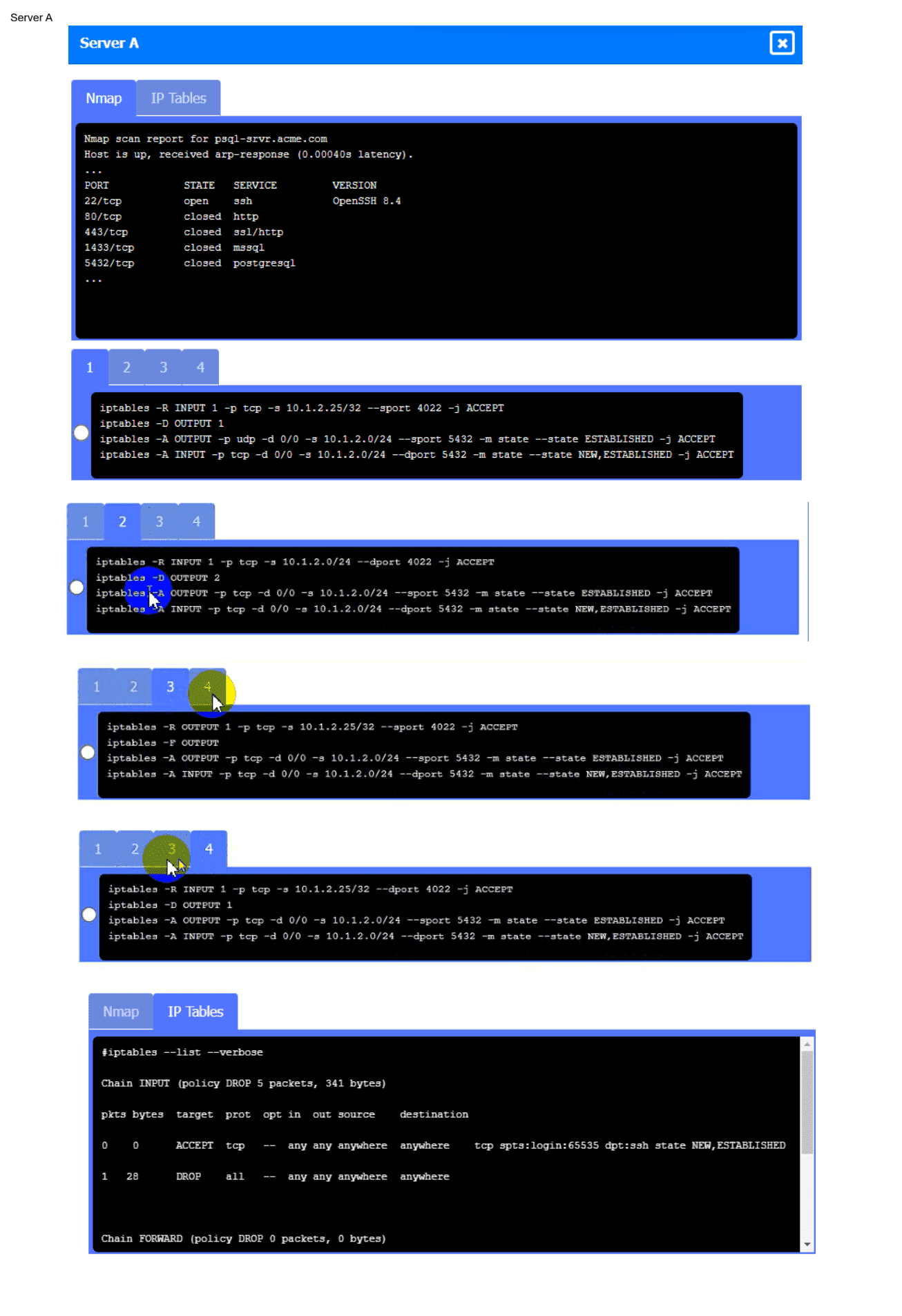
See the Explanation below for the solution.
A security professional is investigating a trend in vulnerability findings for newly deployed
cloud systems Given the following output:
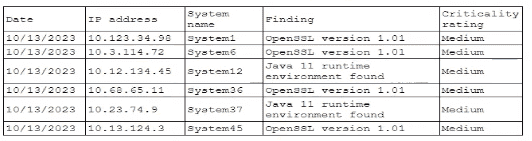
Which of the following actions would address the root cause of this issue?
A. Automating the patching system to update base Images
B. Recompiling the affected programs with the most current patches
C. Disabling unused/unneeded ports on all servers
D. Deploying a WAF with virtual patching upstream of the affected systems
Explanation:
The vulnerability trend shows outdated OpenSSL (version 1.01) and Java 11 runtime appearing repeatedly across multiple newly deployed cloud systems. This indicates the base images used for deployment contain outdated software versions. Fixing individual systems after deployment is reactive; the root cause is the image itself.
Correct Option:
A. Automating the patching system to update base images
The same outdated OpenSSL and Java versions appear on multiple systems (System1, System6, System36, System37, System45).
This pattern strongly suggests a golden image or infrastructure-as-code template with stale packages.
Updating the base image and automating its patching ensures all new deployments are secure from the start.
This addresses the root cause (image provenance) rather than treating symptoms.
Incorrect Options:
B. Recompiling the affected programs with the most current patches
Recompiling individual programs is time‑consuming and does not fix the underlying base image.
New deployments will still use the old image and re‑introduce the same vulnerabilities.
This is a reactive, per‑system fix, not a root‑cause solution for cloud deployments.
C. Disabling unused/unneeded ports on all servers
Port disabling reduces attack surface but does not patch outdated OpenSSL or Java libraries.
Vulnerabilities in OpenSSL can be exploited over any port where the service listens.
This is a compensating control, not a fix for outdated software versions.
D. Deploying a WAF with virtual patching upstream of the affected systems
Virtual patching blocks known exploits but does not remove the underlying vulnerable library.
It adds operational overhead and may miss zero‑days or variations of attacks.
Like port disabling, it is a temporary mitigation, not a root‑cause resolution.
Reference:
CompTIA CAS-005 Exam Objectives — Domain 2: Security Operations (Cloud Security & Automation). NIST SP 800‑190 (Application Container Security Guide) — recommends patching base images. AWS Well‑Architected Framework — Security Pillar: “Use updated AMIs.” CIS Benchmark for Cloud Computing — “Maintain hardened and updated golden images.”
During a recent audit, a company's systems were assessed- Given the following
information:
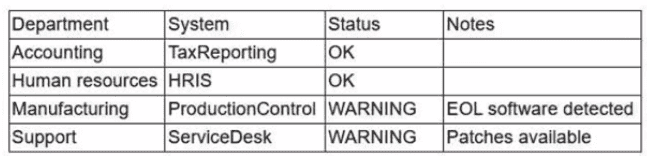
Which of the following is the best way to reduce the attack surface?
A. Deploying an EDR solution to all impacted machines in manufacturing
B. Segmenting the manufacturing network with a firewall and placing the rules in monitor mode
C. Setting up an IDS inline to monitor and detect any threats to the software
D. Implementing an application-aware firewall and writing strict rules for the application access
Explanation:
The audit shows Manufacturing has end-of-life (EOL) software and Support has missing patches. Reducing attack surface means limiting how attackers can interact with vulnerable systems. An application-aware firewall with strict rules restricts allowed traffic to only what is necessary for each application, directly minimizing exposure of EOL or unpatched software.
Correct Option:
D. Implementing an application-aware firewall and writing strict rules for the application access
EOL software cannot be patched, so compensating controls must reduce attack surface.
Application-aware firewalls (e.g., next-gen firewalls) filter based on application protocol, not just ports.
Strict rules allow only legitimate application traffic, blocking exploit attempts against vulnerable services.
This directly reduces exposure without requiring software replacement or network redesign.
Incorrect Options:
A. Deploying an EDR solution to all impacted machines in manufacturing
EDR detects and responds to threats but does not reduce attack surface; it adds detection capability.
EOL software remains vulnerable, and EDR can be bypassed. Attack surface (open ports, running services) stays the same.
B. Segmenting the manufacturing network with a firewall and placing the rules in monitor mode
Monitor mode only observes traffic; it does not enforce segmentation or block malicious access.
Without active blocking, attack surface is unchanged. Segmentation helps only when rules are enforced (block mode).
C. Setting up an IDS inline to monitor and detect any threats to the software
Inline IDS can block some attacks, but it is signature-based and less precise than an application-aware firewall.
It does not reduce attack surface; it merely attempts to detect/block known exploits. EOL software remains fully exposed.
Reference:
CompTIA CAS-005 Exam Objectives — Domain 2: Security Operations (Attack Surface Reduction, Compensating Controls). NIST SP 800-41 (Guidelines on Firewalls and Firewall Policy) — application-aware firewalls reduce exposure. CIS Critical Security Control #12 (Boundary Defense) — restrict unneeded protocols.
| Page 11 out of 36 Pages |