Topic · 12 of 40 questions freeAI governance, risk, and compliance
Question 1
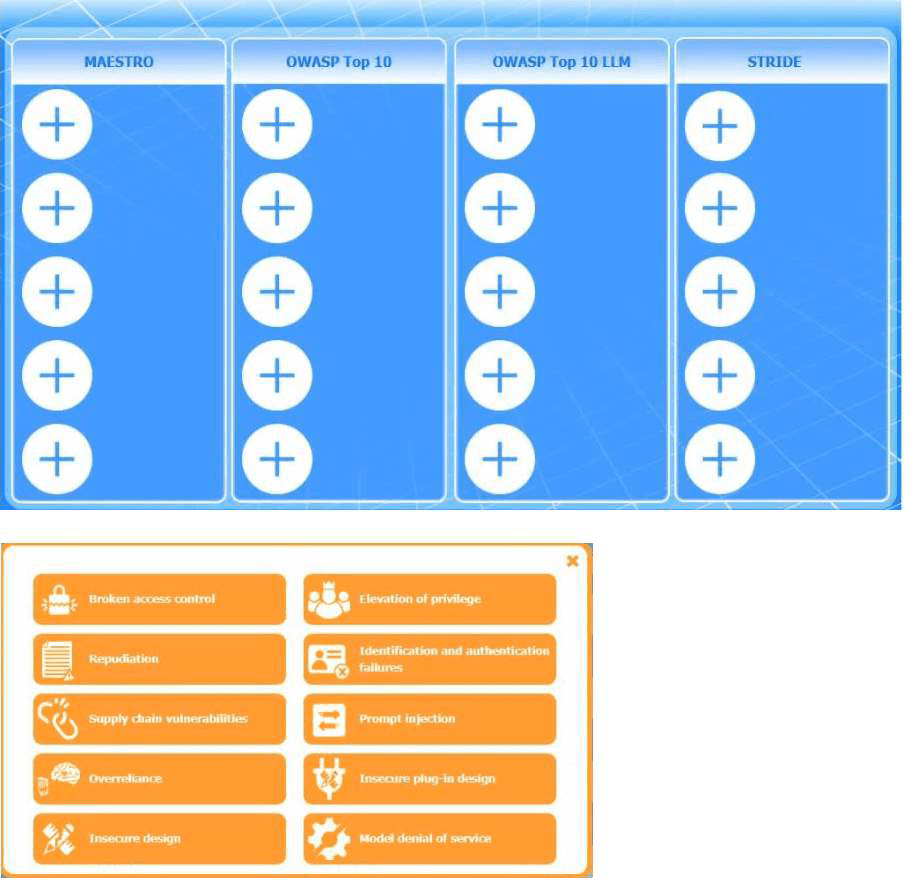
Instructions: Click the (+) to assign each threat category into its appropriate framework.
An architect is modeling an agentic system to meet security standards.
Explanations:
MAESTRO (Agentic Architecture Framework):
Covers agent-specific risks across system layers. Supply chain vulnerabilities affect third-party agent components, models, and dependencies, while Overreliance targets dynamic risks in autonomous decision-making.
OWASP Top 10 (Traditional Web App Security):
Focuses on core application security. Broken access control ($A01:2021$) and Identification and authentication failures ($A07:2021$) address traditional authorization and identity flaws.
OWASP Top 10 for LLM Applications:
Focuses on Generative AI risks. Prompt injection ($LLM01$), Insecure plug-in design ($LLM07$), and Model denial of service ($LLM04$) represent specific direct threats to LLM execution and resource availability.
STRIDE (Threat Modeling Methodology):
A general threat taxonomy created by Microsoft. Repudiation ($R$) and Elevation of privilege ($E$) map directly to its acronym, while Insecure design reflects foundational architectural threat modeling.
Why Misclassifications Are Incorrect
Overreliance & Supply Chain in STRIDE/OWASP Top 10: Legacy STRIDE only covers threat outcomes ($S, T, R, I, D, E$) and does not account for modern multi-agent autonomy or supply chain layers.
Prompt Injection in OWASP Top 10: Standard web applications do not process natural language model contexts; prompt injection is strictly an OWASP Top 10 LLM risk.
Broken Access Control in MAESTRO: While access control applies to agents, the category itself is a foundational web security risk under traditional OWASP Top 10.
OWASP Foundation: OWASP Top 10:2021 and OWASP Top 10 for Large Language Model Applications.
Question 2Choose 1
A line of business wants to onboard an application that uses a custom AI model for
employee assessments. The Chief Information Officer (CIO) agrees to allow the
engagement to proceed but first wants a threat model.
Which of the following is the most appropriate to use for an AI threat model?
Correct answer:
B. Adversarial Threat Landscape for AI Systems (ATLAS)
Explanation:
MITRE ATLAS (Adversarial Threat Landscape for Artificial Intelligence Systems) is the most appropriate framework for threat modeling an AI system. ATLAS is specifically designed to map adversary tactics, techniques, and procedures (TTPs) targeting machine learning and AI systems—covering the entire AI lifecycle from data collection and training to deployment and inference. It provides a structured, attack-centric view that aligns with real-world AI-specific threats such as model evasion, poisoning, extraction, and inference attacks. By using ATLAS, the organization can systematically identify threats, prioritize risks, and implement appropriate countermeasures. ATLAS is the AI counterpart to MITRE ATT&CK, making it the industry standard for AI threat modeling.
Why the other options are incorrect:
A. Responsible AI: Responsible AI is a broad ethical framework focusing on fairness, transparency, accountability, and bias mitigation. While important for employee assessments to ensure non-discriminatory outcomes, it does not address adversarial threats or security vulnerabilities. It is a governance and ethics guideline, not a threat modeling framework.
C. Organization for Economic Co-operation and Development (OECD): The OECD provides high-level principles for trustworthy AI—focusing on human-centered values, transparency, and robust governance. These are policy recommendations, not operational threat modeling frameworks. They lack the detailed TTP mapping required for security analysis.
D. International Organization for Standardization (ISO): ISO standards (e.g., ISO/IEC 42001 for AI management systems) provide compliance and quality management guidelines. While relevant for governance and certification, ISO does not offer adversary-centric threat modeling or attack technique enumeration. It is a management standard, not a security threat framework.
References:
CompTIA SecAI+ CY0-001 Exam Objectives: Domain 3.0 (Securing AI Systems – Threat Modeling) and Domain 2.0 (AI Security Risks and Threats).
MITRE ATLAS: Directly maps AI-specific attack patterns to defensive countermeasures, making it the premier framework for AI threat modeling.
Question 3Choose 1
Faculty members at a university are concerned about potential inherent bias and
inconsistency in one department's AI plagiarism detection service.
Which of the following principles will most likely address their concerns?
Correct answer:
B. Explainability
Explanation:
Explainability is the principle that most directly addresses concerns about inherent bias and inconsistency in an AI plagiarism detection service. Explainability refers to the ability to understand, interpret, and articulate how an AI model arrives at its decisions or predictions in a human-understandable manner. When faculty members question bias or inconsistency—meaning the same submission might receive different scores, or certain writing styles are unfairly flagged—explainability allows them to audit the model's reasoning. It provides transparency into which features (e.g., n-gram overlap, semantic similarity, writing patterns) influenced the plagiarism score, enabling educators to identify whether the model is disproportionately flagging certain writing styles, non-native English patterns, or commonly used phrases. Without explainability, the system remains a "black box," making it impossible to diagnose or correct bias. Explainability builds trust, enables validation, and supports continuous improvement of the AI system.
Why the other options are incorrect:
A. Transparency: Transparency involves openly disclosing how the AI system works, including its training data, development process, and limitations. While related and important, transparency is more about disclosure than understanding. It tells faculty what the system does but does not provide the detailed, per-decision reasoning needed to diagnose bias and inconsistency in individual cases.
C. Consistency: Consistency ensures the model produces the same output for identical or similar inputs over time. However, consistency does not address how the decision was made—it only ensures reproducibility. A model can be consistently biased without revealing that bias, so consistency alone does not address the core concern.
D. Accountability: Accountability assigns responsibility for the AI system's outcomes to specific individuals or roles. It ensures someone is answerable for the system's performance but does not provide the technical insight required to identify or correct bias and inconsistency in the model's decision-making process.
References:
CompTIA SecAI+ CY0-001 Exam Objectives: Domain 1.4 (AI Ethics and Responsible AI – Explainability and Interpretability).
NIST AI RMF (Playbook):Identifies explainability as a key trustworthiness characteristic for high-risk AI applications.
Question 4Choose 1
Which of the following helps in managing potential security issues related to model
training?
Correct answer:
A. National Institute of Standards and Technology (NIST) AI Risk Management Framework
(RMF)
Explanation:
The NIST AI RMF (AI Risk Management Framework) is the most appropriate resource for managing potential security issues related to model training. The NIST AI RMF provides comprehensive, actionable guidance specifically designed for AI systems across the entire lifecycle—including the training phase. It addresses key security risks such as data poisoning (malicious manipulation of training data), data leakage, bias introduction, model integrity, and adversarial robustness. The framework offers a structured approach to identify, assess, and mitigate risks throughout the AI lifecycle, with dedicated sections on securing training pipelines, validating data provenance, and monitoring for drift. Its AI-specific focus makes it directly applicable to model training security challenges.
Why the other options are incorrect:
B. International Organization for Standardization (ISO) 27001: ISO 27001 is an information security management standard for general IT systems. While it provides a foundation for security governance, it does not address AI-specific threats such as data poisoning, model extraction, or adversarial attacks during training. It lacks the technical depth required for model training security.
C. Organization for Economic Co-operation and Development (OECD): The OECD provides high-level principles for trustworthy AI (e.g., transparency, accountability, human-centered values). These are broad governance guidelines, not operational security frameworks for managing technical risks during model training.
D. General Data Protection Regulation (GDPR): GDPR is a privacy and data protection regulation focused on handling personal data. While it imposes requirements on data used for training (e.g., consent, minimization, right to deletion), it does not address model security threats like poisoning, extraction, or adversarial robustness. It is a compliance regulation, not a security risk management framework.
References
CompTIA SecAI+ CY0-001 Exam Objectives: Domain 1.3 (AI Lifecycle – Training Security) and Domain 3.0 (Securing AI Systems – Risk Management).
NIST AI RMF (2023): Explicitly addresses security risks across the AI lifecycle, including training data integrity and model robustness.
Question 5Choose 1
Which of the following International Organization for Standardization (ISO) standards
should be selected for certification to use for third-party assurance for responsible AI
practices?
Correct answer:
D. 42001
Explanation:
ISO/IEC 42001 is the international standard specifically designed for Artificial Intelligence Management Systems (AIMS) . Published in December 2023, it provides a comprehensive framework for organizations to establish, implement, maintain, and continually improve an AI management system. ISO 42001 addresses the entire AI lifecycle—covering development, deployment, monitoring, and governance—with a strong emphasis on responsible AI practices including fairness, transparency, accountability, robustness, and data quality. It also includes requirements for risk assessment, impact analysis, and third-party assurance, making it the ideal standard for certification to demonstrate responsible AI practices to auditors, regulators, and business partners. Organizations seeking third-party validation of their AI governance and responsible AI maturity should pursue ISO 42001 certification.
Why the other options are incorrect:
A. ISO 20000: ISO 20000 is the standard for IT Service Management (ITSM) . It focuses on service delivery, incident management, change management, and service-level agreements. It does not address AI-specific risks, ethics, or responsible AI practices.
B. ISO 27001: ISO 27001 is the standard for Information Security Management Systems (ISMS) . While it provides a robust framework for protecting data and managing security risks, it is general-purpose and does not specifically address AI governance, algorithmic bias, explainability, or responsible AI principles. It complements ISO 42001 but is not the correct choice for responsible AI third-party assurance.
C. ISO 27701: ISO 27701 is a privacy extension to ISO 27001, focusing on Privacy Information Management (PIMS). It addresses personal data protection, consent management, and GDPR compliance. While privacy is a component of responsible AI, ISO 27701 does not cover the broader scope of AI governance, fairness, transparency, or algorithm accountability.
References:
CompTIA SecAI+ CY0-001 Exam Objectives: Domain 1.4 (AI Ethics and Responsible AI) and Domain 3.0 (Securing AI Systems – Compliance and Standards).
ISO/IEC 42001:2023:The first global standard for AI management systems, explicitly designed for responsible AI governance.
Question 6Choose 1
Which of the following is a risk addressed by responsible AI?
Correct answer:
C. Response bias
Explanation:
Response bias is a risk directly addressed by responsible AI. Responsible AI is an ethical and governance framework focused on ensuring that AI systems are fair, transparent, accountable, and non-discriminatory. Response bias refers to systemic prejudiced or skewed outputs that unfairly favor or disadvantage certain individuals or groups based on characteristics such as race, gender, age, or socioeconomic status. This bias can arise from unrepresentative training data, biased labeling, or algorithmic feedback loops that amplify inequities. Responsible AI explicitly seeks to identify, measure, and mitigate such biases through techniques like fairness audits, debiasing algorithms, and diverse data collection, ensuring that AI decisions are equitable and ethical.
Why the other options are incorrect:
A. Model drift: Model drift (or concept drift) refers to the degradation of model performance over time as the statistical properties of input data change. This is an MLOps and performance monitoring concern, not a responsible AI issue. While drift can indirectly affect fairness, it is primarily an operational risk managed through retraining and monitoring.
B. Reputational loss: Reputational loss is a potential consequence of many AI failures—including bias, security breaches, or poor performance—but it is not a risk that responsible AI itself directly addresses. It is a business outcome rather than a specific ethical or fairness concern.
D. Data poisoning: Data poisoning is a security risk where an adversary intentionally corrupts training data to compromise the model's integrity or introduce backdoors. This falls under adversarial machine learning and AI security, not responsible AI. Security frameworks like MITRE ATLAS address data poisoning, while responsible AI focuses on fairness and ethics.
References:
CompTIA SecAI+ CY0-001 Exam Objectives: Domain 1.4 (AI Ethics and Responsible AI – Fairness, Bias Mitigation, and Accountability).
NIST AI RMF: Identifies fairness and bias mitigation as core characteristics of trustworthy AI, explicitly addressing response bias.
Question 7Choose 1
Which of the following responsible AI standards refers to a principle that clearly states the
reasons behind the decisions for a particular conclusion?
Correct answer:
D. Explainability
Explanation:
Explainability refers to the ability of an AI system to provide human-understandable reasoning for its decisions, predictions, or outputs. It answers the question "Why did the model make this specific decision?" by breaking down the contributing factors—such as which input features were most influential, how the model weighed different variables, or what logic led to a particular classification. Explainability is critical for building trust, enabling human oversight, satisfying regulatory compliance (e.g., GDPR's "right to explanation"), and diagnosing issues like bias, errors, or adversarial manipulation. Techniques such as SHAP (SHapley Additive exPlanations), LIME (Local Interpretable Model-agnostic Explanations), and attention visualization are commonly used to provide explainability.
Why the other options are incorrect:
A. Accountability: Accountability assigns responsibility for AI system outcomes to specific individuals, teams, or organizations. It ensures someone is answerable for the system's performance, but it does not provide technical insight into why a decision was made. Accountability is an organizational/governance principle, not a technical capability.
B. Auditability: Auditability is the ability to review and verify an AI system's records, logs, and processes to ensure compliance and detect anomalies. While auditability requires logging and traceability, it does not provide real-time, per-decision reasoning. It is retrospective, while explainability is interpretive.
C. Transparency: Transparency involves openness about how an AI system works—including its training data, algorithms, limitations, and development process. It is high-level disclosure rather than per-instance reasoning. Transparency tells stakeholders what the system is, while explainability tells them why it made a particular output.
References:
CompTIA SecAI+ CY0-001 Exam Objectives: Domain 1.4 (AI Ethics and Responsible AI – Explainability and Interpretability).
NIST AI RMF: Identifies explainability as a core trustworthiness characteristic for AI systems.
Question 8Choose 1
Which of the following helps end users within an organization the most in safeguarding
against the risk of AI-related non-compliance?
Correct answer:
B. Policies and procedures
Explanation:
Policies and procedures help end users the most in safeguarding against the risk of AI-related non-compliance because they provide clear, actionable guidance on what is permitted, what is prohibited, and how to handle AI interactions responsibly. End users are often the first line of defense against compliance violations—such as inadvertently sharing sensitive data (PII, PHI, financial information) with public AI models, using unapproved AI tools, or misusing AI-generated content. Well-documented policies (e.g., acceptable use, data handling, privacy, and AI governance policies) combined with step-by-step procedures empower users to make compliant decisions in their daily workflows. Policies establish the rules, while procedures provide the "how-to" for compliance—covering areas like data classification, approved AI tool lists, prompt restrictions, and reporting obligations. This user-centric approach reduces human error, builds a culture of compliance, and ensures that end users understand their responsibilities.
Why the other options are incorrect:
A. AI center of excellence (CoE): An AI CoE is a centralized team of experts that establishes best practices, governance, and technical standards for AI adoption. While it plays a strategic role in shaping compliance frameworks, it does not directly help end users on a day-to-day basis. The CoE creates policies, but end users rely on the policies themselves for guidance.
C. Implementing data loss prevention (DLP): DLP is a technical control that monitors, detects, and blocks unauthorized data transfers. While it is an effective security measure, it operates in the background and does not educate or guide end users. DLP is reactive and preventive at the system level, not user-facing compliance support.
D. Enabling multifactor authentication (MFA) for access: MFA is an authentication control that strengthens access security. It does not address AI-specific compliance risks such as data privacy, acceptable use, or algorithmic fairness. MFA protects against unauthorized access but does not guide users on compliant AI usage.
References:
CompTIA SecAI+ CY0-001 Exam Objectives: Domain 1.4 (AI Ethics and Responsible AI – Governance and Policies) and Domain 3.1 (Securing AI Systems – User Awareness and Compliance).
NIST AI RMF: Emphasizes the importance of policies and procedures in managing AI risks and ensuring compliance.
Question 9Choose 1
A security consultant must summarize the impact of posture management on a machine
learning (ML) use case.
Which of the following is the most appropriate reference for this purpose?
Correct answer:
B. National Institute of Standards and Technology (NIST) AI Risk Management Framework
(RMF)
Explanation:
The NIST AI Risk Management Framework (RMF) is the most appropriate reference for summarizing the impact of posture management on an ML use case because it provides comprehensive, actionable guidance for managing AI-specific risks across the entire lifecycle—including deployment, monitoring, and governance. Posture management in AI refers to the continuous assessment, monitoring, and improvement of an AI system's security, compliance, and operational health. The NIST AI RMF directly addresses this through its core functions: GOVERN (establishing governance and accountability), MAP (understanding the AI system's context and risks), MEASURE (assessing and monitoring risks and performance), and MANAGE (implementing and maintaining risk treatments). This framework explicitly covers the operational and security posture of AI systems, making it the ideal reference for a consultant summarizing how posture management affects an ML use case.
Why the other options are incorrect:
A. Organization for Economic Co-operation and Development (OECD) standards: The OECD provides high-level, principles-based recommendations for trustworthy AI (e.g., human-centered values, transparency). While foundational, these are not operational security or posture management frameworks and lack the technical depth needed to assess ML deployment posture.
C. European Union AI Act: The EU AI Act is a regulatory compliance framework that categorizes AI systems by risk level (unacceptable, high, limited, minimal). It focuses on legal and regulatory obligations rather than operational posture management. It is a compliance mandate, not a technical reference for posture assessment.
D. Generative adversarial network (GAN): A GAN is a specific type of deep learning architecture used for generating synthetic data. It is a technical model, not a governance or posture management framework. It is entirely irrelevant to summarizing posture management impact.
References:
CompTIA SecAI+ CY0-001 Exam Objectives: Domain 1.3 (AI Lifecycle – Governance and Posture Management) and Domain 3.0 (Securing AI Systems – Risk Management Frameworks).
NIST AI RMF (2023): The premier framework for AI risk and posture management.
Question 10Choose 1
A security architect performs threat modeling of an AI system. The architect needs to
determine which attacks can be performed against the system.
Which of the following actions should the architect take next?
Correct answer:
D. Analyze MITRE Adversarial Threat Landscape for AI Systems (ATLAS) for tactics,
techniques, and procedures (TTPs).
Explanation :
Analyzing MITRE ATLAS for TTPs is the correct next action for a security architect performing threat modeling of an AI system who needs to determine which attacks can be performed against the system. MITRE ATLAS is the definitive knowledge base of adversary tactics, techniques, and procedures (TTPs) specifically targeting machine learning and AI systems. It maps the entire AI lifecycle—from data collection and training to deployment and inference—and covers AI-specific attacks such as model evasion, poisoning, extraction, inference, and denial-of-service. By analyzing ATLAS, the architect can systematically identify which TTPs are applicable to their system's architecture, data flows, and components. This adversary-centric approach provides a comprehensive, threat-informed view of potential attack vectors, enabling the architect to prioritize defenses based on real-world adversarial behavior.
Why the other options are incorrect:
A. Leverage an LLM to map likely attack paths based on the code base: Using an LLM to analyze code for attack paths is speculative and unreliable. LLMs may produce hallucinations, miss context, or generate false positives. It does not replace the structured, validated threat intelligence provided by MITRE ATLAS.
B. Quantify the risk of known vulnerabilities identified in the AI system: Quantifying risk (e.g., CVSS scoring) is a subsequent step after identifying threats and vulnerabilities. The architect first needs to determine which attacks are possible—which ATLAS provides—before quantifying their risk.
C. Identify trust boundaries and perform threat modeling with OWASP Top 10: OWASP Top 10 for LLMs provides a list of common vulnerabilities (e.g., prompt injection, insecure output handling) but is not a comprehensive TTP-based threat modeling framework. It does not map adversary behaviors or attack chains. Trust boundary identification is part of threat modeling but is not the next step for determining which attacks can be performed.
References:
CompTIA SecAI+ CY0-001 Exam Objectives: Domain 2.0 (AI Security Risks and Threats) and Domain 3.0 (Securing AI Systems – Threat Modeling).
MITRE ATLAS:The industry-standard framework for AI-specific adversarial TTPs.
Practice Like It's Exam Day
Get exam-ready with a timed CY0 001 CompTIA SecAI+ v1 mock exam designed to match the official exam's question format, question count, and time limit.