Free CompTIA PK0-005 Practice Questions 2026 - Page 15
During the execution phase of a project, the project team faced an unexpected website downtime The project manager how a brainstorming session and the team identified causes and effects tor the problem Now the project team needs to analyze and determine whether the particular cause and effect are related by using one of the following charts.
Which of the following should the team use?
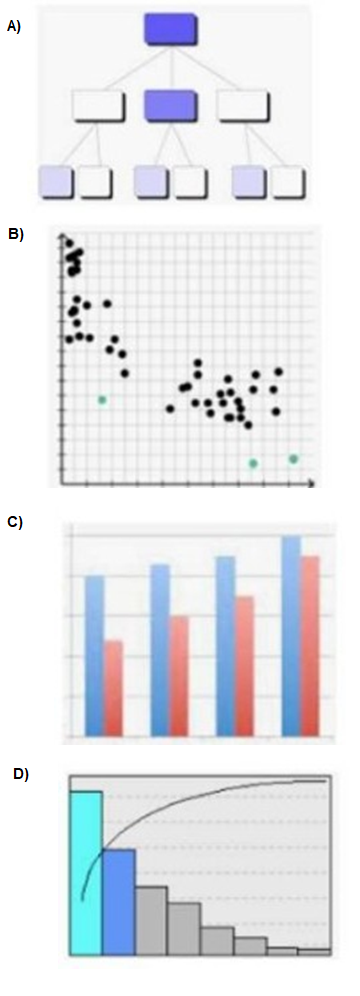
A. Option A
B. Option B
C. Option C
D. Option D
Explanation:
The scenario describes a need to determine if a cause and effect are related. In project management and quality control, this specific analysis is done using a Scatter Diagram.
✅ Why Option B is correct
A Scatter Diagram (also called a scatter plot) plots pairs of numerical data, with one variable on each axis, to look for a relationship between them. If the points follow a pattern (like a line), it confirms a correlation between the two variables. In this case, the PM would use it to see if a specific "cause" (like high traffic volume) has a direct mathematical relationship with the "effect" (like website response time).
❌ Why Option A is incorrect
This is a Hierarchical Chart (like a WBS or an Organizational Chart). It is used to show structure and the decomposition of work or people, not to analyze relationships between variables.
❌ Why Option C is incorrect
This is a Bar Chart or Histogram. It is used to compare different categories of data (e.g., sales per month) or show frequency, but it doesn't show the mathematical correlation between two variables.
❌ Why Option D is incorrect
This is a Pareto Chart. While it is used for "root cause analysis," its specific purpose is to prioritize causes by the 80/20 rule (finding the 20% of causes that result in 80% of the problems). It doesn't prove a statistical relationship between a single cause and its effect.
📚 Exam Reference
Domain: Project Documentation and Controls (Domain 2.0)
Topic: Quality Control Tools (Scatter Diagrams, Pareto Charts, and Fishbone Diagrams)
A visual that displays team progress was created for stand-up meetings. Which of the following BEST describes what is being represented on the visual?
A. Decision board
B. Whiteboard
C. Task board
D. Dashboard
Explanation:
In Agile or stand-up meetings, teams commonly use a task board (often called a Kanban board) to visually display the progress of work items.
A task board typically shows columns such as:
To Do
In Progress
Testing
Done
Team members move tasks across the board during the daily stand-up, allowing everyone to quickly see:
Current work status
Task ownership
Bottlenecks
Overall team progress
This visual tool supports transparency and quick updates during stand-up meetings.
Why the Other Options Are Incorrect
A. Decision board
A decision board is not a standard project management tool used to track task progress.
B. Whiteboard
A whiteboard is a general tool for writing or brainstorming, but it does not specifically represent structured task progress.
D. Dashboard
A dashboard provides high-level metrics and KPIs for stakeholders, not the day-to-day task tracking used in stand-ups.
Reference
CompTIA Project+ PK0-005 – Agile Practices / Visual Project Management
Agile teams commonly use:
Task boards (Kanban boards)
Daily stand-up meetings
Visual workflow tracking to monitor task progress.
Which of the following activities would force a team to remove a new package and leave the previous one during a smoke test?
A. Rollback plan
B. Downtime stage
C. Maintenance window
D. Validation checks
Explanation:
A rollback plan is a set of procedures designed to restore a system to its previously stable state if a new deployment fails or causes critical issues. During a smoke test (a quick suite of tests to ensure the most important functions work), if the new package fails, the team forces the removal of the new code and reverts to the previous version using this plan. This ensures service continuity and minimizes the impact of a failed release.
Incorrect Answers
B. Downtime stage
Why it's incorrect: Downtime is the period during which a system is unavailable to users while an update or maintenance is performed. While a rollback might occur during a downtime stage, the stage itself is a period of time, not the action or activity that forces the removal of a package.
C. Maintenance window
Why it's incorrect: Similar to downtime, a maintenance window is a pre-scheduled timeframe set aside for technical work. It provides the slot for the deployment, but it is not the mechanism used to revert a failed package.
D. Validation checks
Why it's incorrect: Validation checks (like the smoke test mentioned in the question) are the reason you might decide to roll back, but they are not the activity that performs the removal. Validation identifies the problem; the rollback plan fixes it by returning to the previous state.
References
CompTIA Project+ (PK0-005) Exam Objectives: Domain 4.2 – Given a scenario, execute a transition plan (specifically the Rollback/Reversion component of a deployment).
Which of the following factors would be impacted the most by requirements for a project to implement an air quality control system at a coal plant?
A. Social
B. Regulatory
C. Environmental
D. Governmental
Explanation:
The question describes a project to implement an air quality control system at a coal plant. This type of project is directly related to managing and reducing the environmental impact of the plant's operations.
Why C is correct:
Air quality control systems are designed to reduce pollutants released into the atmosphere. This directly addresses the environmental impact of the coal plant. The requirements for such a system are primarily driven by the need to protect the environment and comply with environmental standards. Therefore, environmental factors are impacted the most.
Why A is incorrect:
Social factors relate to the impact on people and communities. While improved air quality has social benefits (better health for nearby communities), the primary driver and focus of the requirements are environmental. The system itself is environmental in nature.
Why B is incorrect:
Regulatory factors refer to laws and regulations that must be followed. Air quality control systems are often required by environmental regulations. However, the question asks which factor is impacted by the requirements. The requirements impact the environment by reducing pollution. Regulations are the cause of the requirements, not the factor being impacted.
Why D is incorrect:
Governmental factors relate to the actions and policies of government bodies. Similar to regulatory, government may set the rules, but the system's requirements directly impact the environment, not the government itself.
References:
CompTIA Project+ PK0-005 Objective 1.1: Compare and contrast basic project management concepts. This objective includes an understanding of Environmental, Social, and Governance (ESG) factors and how they can influence project initiation and execution.
A project coordinator has started a new project and is reviewing the following
characteristics provided by the customer:
• Two developers
• High uncertainty about existing systems
• Risk of frequent requirement changes
• Tight deadlines
Which of the following project methodologies would be best to use in this situation?
A. PRINCE2
B. Scrum
C. SAFe
D. XP
Explanation:
The project has these key characteristics:
Very small team: Only two developers (extremely small cross-functional team).
High uncertainty about existing systems (implies unclear or evolving technical landscape, common in exploratory or innovative work).
Risk of frequent requirement changes (volatile or unclear customer needs, typical of adaptive projects).
Tight deadlines (need for rapid delivery and quick feedback cycles).
These traits strongly favor an Agile methodology that supports:
Small team sizes
Iterative development
Frequent adaptation to changing requirements
Short delivery cycles to meet tight timelines
Handling of uncertainty through regular inspection and adaptation
Why Scrum is the best fit:
It is designed for small, cross-functional teams (ideal Scrum team size is 3–9 people; two developers can function as a tiny Scrum team with the coordinator potentially acting as Scrum Master/Product Owner or combining roles).
It excels in environments with high uncertainty and frequent changes via short Sprints (typically 1–4 weeks), daily stand-ups, Sprint Reviews (for frequent feedback), and Sprint Retrospectives (for adaptation).
It allows quick delivery of working increments to meet tight deadlines through prioritized backlogs and time-boxed iterations.
Scrum provides just enough structure (roles, events, artifacts) without being overly prescriptive, making it suitable for small teams facing volatility.
Why the other options are incorrect:
A. PRINCE2 — A predictive (waterfall-like), process-heavy, governance-focused methodology best for large, complex, high-risk projects with stable requirements. It is too rigid, documentation-intensive, and stage-gate oriented for a tiny team with high uncertainty, frequent changes, and tight deadlines — it would slow things down.
C. SAFe (Scaled Agile Framework) — Designed for large-scale enterprises with multiple teams (ARTs, program levels, portfolio alignment). It adds significant overhead (PI planning, roles like RTE, etc.) and is overkill — even counterproductive — for a project with only two developers. SAFe is not suited to small, standalone efforts.
D. XP (Extreme Programming) — An Agile methodology focused on engineering practices (pair programming, TDD, continuous integration, small releases). While it handles changes and uncertainty well, it is more prescriptive on technical practices (e.g., mandatory pair programming — which could be challenging or forced with exactly two developers). XP is often used within Scrum teams rather than as a standalone methodology for the entire project. Scrum is broader and more flexible for overall project management in this scenario.
In CompTIA Project+ (PK0-005), this question tests knowledge of selecting appropriate methodologies/frameworks based on project constraints (Exam Objective 1.1 — Compare characteristics of various project methodologies — including predictive, Agile, Scrum, XP, SAFe — and when to use each). Scrum is repeatedly highlighted in the objectives and study materials as the go-to for small teams, changing requirements, uncertainty, and iterative delivery under time pressure.
A project manager is in the closing phase of an IT asset refresh project that involves the disposal of several computers. The project sponsor notified the project manager that the company recently received a penalty as a result of disposing of some computers improperly. Which of the following should have been considered during initial planning to prevent this situation?
A. ESG
B. PHI
C. Pll
D. ROI
Explanation:
The scenario involves disposing of computers improperly, which led to a penalty. This directly ties to ESG considerations, specifically the environmental aspect of responsible disposal and sustainability. ESG frameworks ensure organizations account for environmental impacts, social responsibility, and governance practices during project planning and execution.
ESG (A): Correct
Proper disposal of IT assets falls under environmental responsibility, which is part of ESG.
PHI (B):
Protected Health Information — relates to healthcare data privacy, not relevant here.
PII (C):
Personally Identifiable Information — relates to safeguarding personal data, not disposal of hardware.
ROI (D):
Return on Investment — financial metric, not related to compliance or penalties from improper disposal.
Reference:
This aligns with CompTIA Project+ PK0-005 Exam Objective 1.1 (Project Characteristics and Influences), which highlights ESG factors as external influences that must be considered during project planning. In IT asset refresh projects, ESG ensures compliance with environmental regulations and corporate responsibility standards.
Which of the following BEST describes how an organization should coordinate management of multiple related projects?
A. Apply the SDLC process
B. Establish a program.
C. Consult the CCB.
D. Use different frameworks
Explanation:
In project management, there is a clear hierarchy for managing work based on how projects relate to one another. When multiple projects share a common goal or are interdependent, they are grouped into a Program.
Why B is correct:
A Program is defined as a group of related projects managed in a coordinated way to obtain benefits and control not available from managing them individually. For example, if a company is launching a new satellite, the "Satellite Program" might include a project for the hardware, a project for the software, and a project for the ground station. Managing them together ensures they all align and share resources effectively.
Why A is incorrect:
The SDLC (Software Development Life Cycle) is a process used specifically for developing software (Plan, Design, Build, Test, Deploy). It is a methodology for a single project, not a management structure for multiple related projects.
Why C is incorrect:
The CCB (Change Control Board) is a formal group responsible for reviewing, evaluating, and approving or rejecting changes to a project's baseline. It does not coordinate the high-level management of multiple projects.
Why D is incorrect:
Using different frameworks (like mixing Scrum and Waterfall) is a tactical choice, but it doesn't solve the problem of "coordinating" the relationship and dependencies between multiple projects. In fact, using too many different frameworks without a central program structure can make coordination harder.
Reference:
Domain: Project Fundamentals (Domain 1.0)
A developer recommends modifying an existing portion of code that is not part of the scope and is causing low performance on the current solution. Which of the following actions should the project manager most likely take?
A. Ask a developer to create a change request.
B. Do nothing because recommendation is scope creep.
C. Ask a developer to implement the recommendation.
D. Communicate the change status.
Explanation:
The developer is proposing a modification to existing code that is outside the current project scope. Any change that affects the approved scope, schedule, or cost must follow the formal change management process.
The correct first step is to submit a change request, which allows the project team and stakeholders to:
- Perform impact analysis
- Evaluate effects on scope, cost, schedule, and risk
- Decide whether to approve or reject the change
This ensures proper governance and prevents uncontrolled scope changes.
Why the Other Options Are Incorrect:
B. Do nothing because recommendation is scope creep.
While the suggestion is outside scope, it could still be valuable for improving performance. It should be evaluated through the change control process, not ignored.
C. Ask a developer to implement the recommendation.
Implementing the change immediately would bypass change control, which could lead to unapproved scope changes.
D. Communicate the change status.
The change does not yet have a status until a formal change request is submitted and reviewed.
Reference:
CompTIA Project+ PK0-005 – Change Management
Typical change control process:
- Submit a change request
- Perform impact analysis
- Review by Change Control Board (CCB) if needed
- Approve or reject
- Implement and document the change.
During a brainstorming session, a project team is elaborating on what caused the unexpected crash of the website that the team was developing. Given the following:

Which of the following was the initial cause of the issue?
A. Inadequate memory
B. Incorrect configuration
C. Lack of infrastructure
D. Inadequate instructions
Explanation:
This question provides a visual example of an Ishikawa (Fishbone) diagram, which we touched on earlier. It tests your ability to interpret the specific data points within the diagram to identify the root cause or initial trigger of an issue.
Correct Answer:
B. Incorrect configuration
Looking at the diagram under the "System" category, "Misconfiguration" is explicitly listed as a potential cause for the website crash. In IT project management, a configuration error (such as a wrong port setting, an incorrect API key, or a server setup mistake) is a primary technical "root cause" that leads to system failures. Among the choices provided, "Incorrect configuration" directly maps to the "Misconfiguration" branch shown in the team's analysis.
Incorrect Answers:
A. Inadequate memory
Why it's incorrect: While memory issues can cause crashes, "Memory" or "Resources" are not listed anywhere on the provided fishbone diagram. You must base your answer strictly on the evidence presented in the image.
C. Lack of infrastructure
Why it's incorrect: The diagram lists "System" and "Process" issues, but it does not specify a total lack of infrastructure (like missing servers or hardware). The "System" branch points to software/setup issues (Outdated software/Misconfiguration) rather than a lack of physical assets.
D. Inadequate instructions
Why it's incorrect: This is a strong distractor. The diagram mentions "Assumed process is obvious" under the Human category, which implies a lack of clarity. However, "Incorrect configuration" is a more direct technical cause for a website crash listed under the System branch, whereas inadequate instructions are usually the cause of a process failure rather than a system-level crash.
References:
CompTIA Project+ (PK0-005) Exam Objectives: Domain 1.6 – "Given a scenario, use appropriate phase-related reports/tools" (Interpret Fishbone diagrams).
PMBOK Guide (6th/7th Edition): Quality Management section. It explains that the "head" of the fish represents the problem statement, and the "bones" represent categories of causes (Human, System, Process) used to trace back to the root cause.
Which of the following metrics BE ST measures the alignment of the information security program to operational objectives?
A. Percentage of controls with identified business owners
B. Percentage of risk investments with defined business cases
C. Ratio of control cost to operational budget
D. Senior management satisfaction scores related to the security program
Explanation:
The question asks which metric best measures the alignment of the information security program to operational objectives. The key phrase is alignment to operational objectives.
Percentage of controls with identified business owners (A):
This measures accountability, but not direct alignment to operational objectives.
Percentage of risk investments with defined business cases (B): Correct
A business case ties a risk investment directly to operational goals, ensuring that security spending supports organizational objectives. This is the strongest measure of alignment.
Ratio of control cost to operational budget (C):
This measures financial efficiency, but not alignment.
Senior management satisfaction scores (D):
This is subjective feedback, not a concrete measure of alignment.
Thus, B is the most objective and operationally aligned metric.
Reference:
This aligns with CompTIA Project+ PK0-005 Exam Objective 4.1 (Project Measurement and Metrics), which emphasizes using business cases and risk investments to demonstrate alignment between project/security initiatives and organizational goals.
| Page 15 out of 44 Pages |